

How To Check Dns In Windows 10
Who's doing the work for you?
How to quickly notice the DNS servers used by Windows. They're typically specified by your Internet service provider, simply I'll also hash out why you lot might modify your DNS servers.
How exercise I observe the domain name server on my PC?
The DNS (Domain Name Arrangement) server used by your PC maps domain names (like "askleo.com") to IP addresses (like 54.244.218.224).
Your reckoner could be using several different DNS servers.
I'll await at how to discover which servers your figurer is configured to use, and discuss a couple of situations where you might want to utilise something different.

To view the DNS being used by Windows, run a Command Prompt, and blazon "ipconfig /all" followed by Enter. "DNS Servers" will be listed in the information displayed.
The DNS yous use
The easiest way to determine what DNS server you're using is via Windows Command Prompt.
In Windows 10, right-click on the Start menu and click on Command Prompt (or Windows PowerShell — either will do). In nigh other versions of Windows, click on Start, then All Programs, then Accessories, and finally onCommand prompt.
Type "ipconfig /all" followed past Enter. You'll get a lot of information.
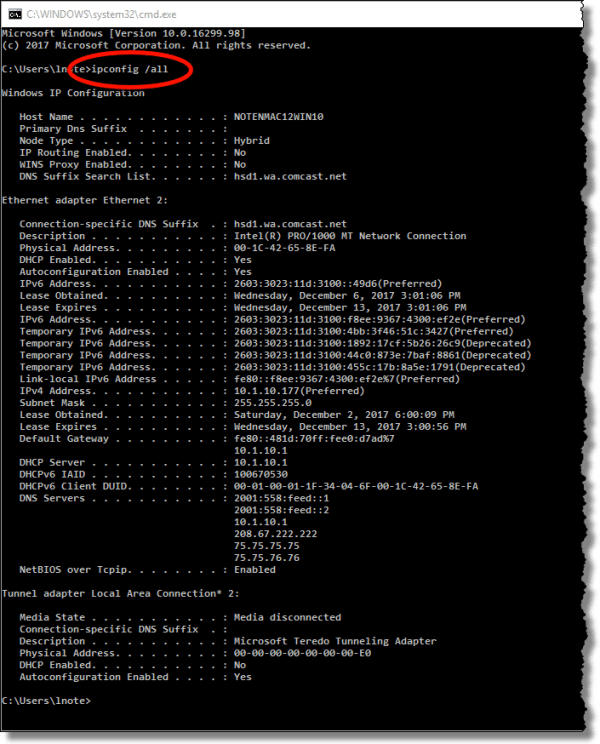
In the midst of all that information, you can come across "DNS Servers" listed. Typically, there are multiple servers that provide backup access if one fails to reply.
| DNS Servers . . . . . . . . . . . : | 2001:558:feed::ane |
| 2001:558:feed::two | |
| x.1.x.1 | |
| 208.67.222.222 | |
| 75.75.75.75 | |
| 75.75.76.76 |
In my instance, I accept several DNS servers listed: two IPv6 addresses (those with colons between the numbers – ":") and an IPv4 accost (those with periods – "."). The commencement three signal to my router (a inkling is that 10.1.10.1 is too the "gateway address"). The 2d three addresses point to external DNS services.
Yours volition almost certainly exist different.
Where DNS settings come from
Unless you override them, DNS settings are assigned past your ISP. When your router connects to the internet and asks your Internet access provider for an IP address, the response includes the IP addresses of one or more DNS servers. When your calculator asks your router for an IP accost on your local network, the router responds in one of three ways:
- It passes on the DNS information it was given by your Internet service provider.
- It returns its own IP accost, meaning the router itself will human action as your DNS server.
- It returns a combination of both, as you've seen in my example above.
When a router acts as your DNS server, it can increase speed. Each time a DNS request is made, the router remembers the answer. Then, when a asking for the same data is made again — a common occurrence — it can just return the response it already knows without needing to attain out to a DNS server on the internet.
If your computer'southward DNS is set to your router'southward IP address, virtually normally a unmarried DNS server is listed, and it's the same as the "Default Gateway" listed in the ipconfig output. To see what DNS server you're actually using for requests the router can't fulfill, check the router's configuration. Exactly how y'all do that depends on your router, so bank check the documentation that came with it.
Why change DNS?
In most cases, it's quite appropriate to use the DNS servers provided by your ISP, only you're not required to.
In that location are two reasons to consider culling DNS services: speed and security.
Some public DNS servers are designed to be fast. Possibly more pragmatically, some Isp's DNS servers aren't designed to be fast; they're just there because the Internet service provider is "supposed" to provide DNS services. Switching to a different service can speed up the response time. If you lot find pages consistently have a long time the very first time you visit a website, or yous run into phrases like "resolving <domain name>" in your browser's status bar for a long fourth dimension, then trying a faster DNS service might be indicated.
Google's Public DNS is one such service.
DNS services such every bit OpenDNS and Quad9 (named afterward their IP address: 9.ix.9.9) add together an boosted service: security. Both cake known malicious sites. If you take malware, or are in the process of falling for a phishing attempt, these services tin can protect you past blocking or redirecting a request that would land you on a site known to be malicious. OpenDNS also has adult-content and custom filtering available.
Culling DNS servers aren't for everyone, and they certainly aren't required. But if you're experiencing a DNS-related speed issue or are looking for additional protection they might be worth investigating.
Podcast sound
Video Narration


Source: https://askleo.com/find-dns-server-used-pc/
Posted by: lebrunbagat1936.blogspot.com
0 Response to "How To Check Dns In Windows 10"
Post a Comment